
P&C Insurance Integration Guide
Duck Creek + Microsoft Dynamics 365: An Integration Guide for P&C Insurers
Duck Creek and Microsoft Dynamics 365 are complementary platforms. Duck Creek manages the insurance core, while Dynamics 365 supports customer engagement, service and corporate operations. The integration succeeds when data ownership, security, events and reconciliation are designed before tools are selected.
Reviewed by Managed ERP Services | Dynamics 365 Solution Architecture Team
Published September 9, 2026 · Last updated September 9, 2026 · About 12 min read
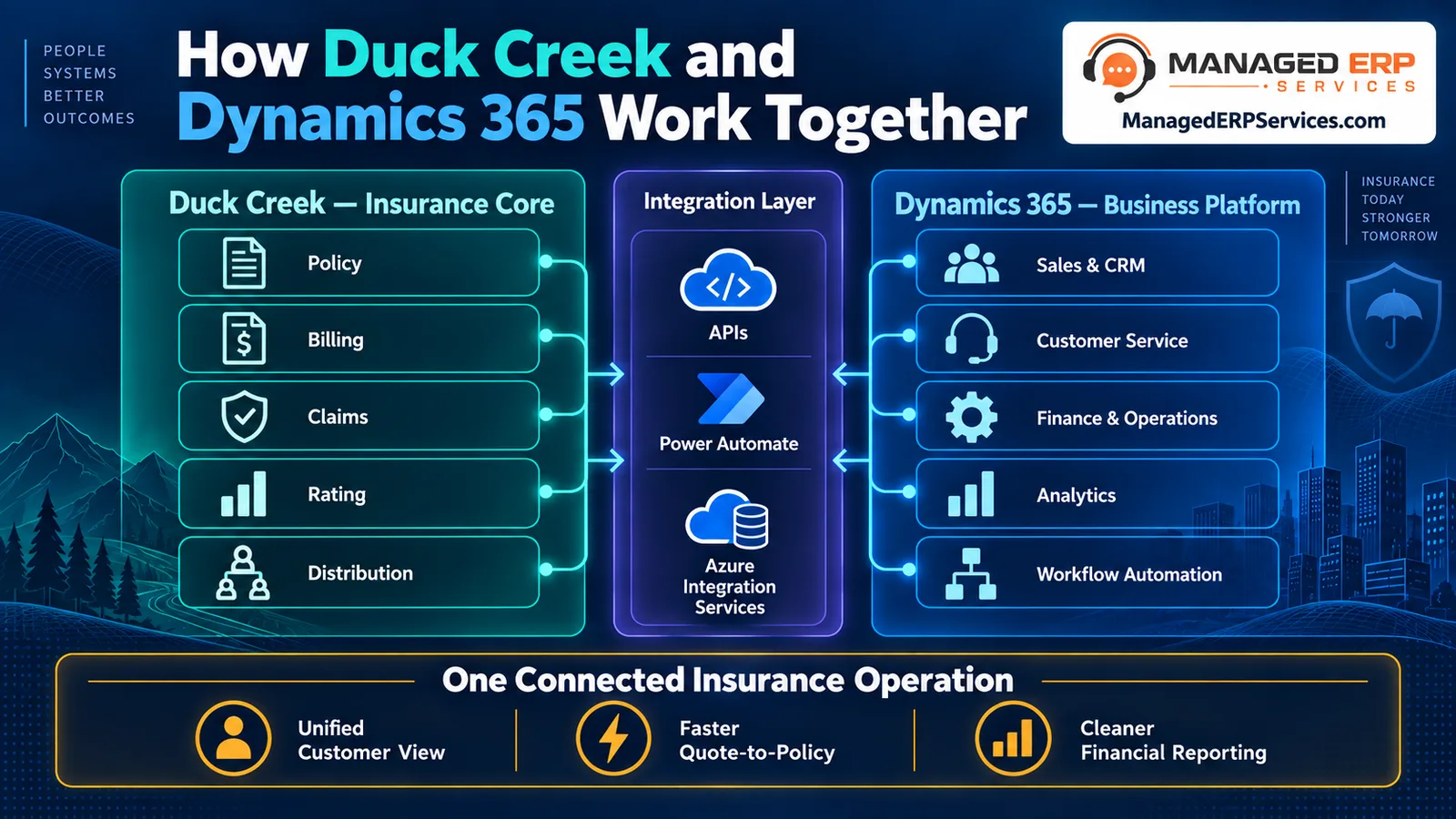
Duck Creek and Microsoft Dynamics 365 are complementary platforms, not direct replacements. Duck Creek can run the core insurance lifecycle — policy, rating, billing, claims and distribution — while Dynamics 365 can manage customer relationships, service cases, corporate finance, procurement and operational workflows. The business value appears when the two platforms exchange the right data through a governed integration architecture without creating duplicate systems of record.
For a property and casualty insurer, MGA or insurance group, that distinction should be made before implementation decisions, data models and integrations are locked in.
What is Duck Creek?
Duck Creek Technologies provides insurance software designed for P&C carriers. Its applications can support the central transactions and workflows that keep an insurance operation moving:
- Policy: product configuration, quoting, issuance, endorsements, renewals and cancellations
- Rating: premium calculations based on risk information, underwriting rules, rate content and jurisdictional requirements
- Billing: premium invoicing, payment plans, collections, commissions and related insurance billing activity
- Claims: first notice of loss, investigation, reserving, payment, recovery and claim closure
- Distribution Management: producer onboarding, licensing, appointments, compensation, performance and agency self-service
- Data and insights: operational and analytical access to policy, billing, claims and related insurance data
- Digital engagement: policyholder and producer experiences, including self-service capabilities
Duck Creek describes its current OnDemand offering as a SaaS suite underpinned by Microsoft Azure. Its platform also emphasizes low-code configuration, allowing trained teams to change products, rules and workflows with less dependence on custom development than a traditional legacy core may require.
In plain language, Duck Creek is the insurance transaction engine. It is responsible for insurance-specific records and processing that a general CRM or ERP platform is not designed to replace.
How much does Duck Creek cost?
Duck Creek does not publish standard list pricing. A realistic budget normally depends on the scope and operating model rather than a simple per-user price. Important cost drivers include:
- Applications selected, such as Policy, Billing, Claims, Rating or Distribution Management.
- Policy, premium, claim, user and transaction volumes.
- Number of states, countries, products and lines of business.
- Product configuration and deviation from standard content.
- Legacy policy and claim conversion requirements.
- Number and complexity of integrations.
- Data quality, archival, reconciliation and reporting requirements.
- Testing, regulatory validation, training and organizational change.
- Implementation-partner model and ongoing support responsibilities.
Insurers should request a scoped commercial proposal and compare the total cost of ownership across at least three scenarios: minimum viable scope, target-state scope and a phased migration. The business case should include internal staffing, conversion, integration operations, testing, training and post-go-live support — not only software subscription fees.
Can Duck Creek be customized?
Yes, but "configurable" and "customized" should not be treated as the same thing.
Duck Creek's low-code capabilities can support product definitions, rules, workflows, rates, forms and other insurance processes. Carriers can use standard and industry content as a starting point and add proprietary underwriting, pricing or servicing rules.
The design goal should be to use governed configuration first and custom extensions only where they produce a defensible business advantage. Excessive customization can increase testing effort, make integrations harder to support and reduce the economic benefit of a SaaS operating model.
For new programs, Duck Creek OnDemand is the relevant strategic SaaS offering. Insurers with older Duck Creek estates should document their actual version, hosting model, customizations and upgrade path before designing a Dynamics 365 integration.
Where does Microsoft Dynamics 365 fit?
Duck Creek handles insurance-specific processing. Dynamics 365 can manage customer engagement and broader business operations around that core.
| Business capability | Primary platform role |
|---|---|
| Policy, rating, claims and premium billing | Duck Creek |
| Lead, opportunity, relationship and account management | Dynamics 365 Sales |
| Policyholder inquiries, complaints, queues, SLAs and knowledge | Dynamics 365 Customer Service |
| Corporate general ledger, accounts payable, procurement, fixed assets and consolidation | Dynamics 365 Finance and Supply Chain Management |
| Finance and operations for smaller or mid-sized entities | Dynamics 365 Business Central |
| Approvals, notifications and human-centered workflows | Power Automate, where volume and limits are appropriate |
| Durable enterprise integration and event processing | Azure integration services, selected for the workload |
| Cross-platform reporting and analytics | A governed data platform with Power BI or Microsoft Fabric, where appropriate |
Scroll the table horizontally to see all columns.
Dynamics 365 Sales
Dynamics 365 Sales can give producers, account executives and relationship teams a structured view of prospects, customers, opportunities, activities and renewal or cross-sell opportunities. Selected policy and claim summaries can be displayed in Dynamics 365, while Duck Creek remains authoritative for the underlying insurance contracts and transactions.
Dynamics 365 Customer Service
Customer Service can manage policyholder inquiries, complaints, service cases, queues, service-level agreements, knowledge and omnichannel interactions. A service representative might see policy status, billing status or a claim summary without being given unnecessary access to every core insurance record.
Dynamics 365 Finance and Business Central
Duck Creek Billing manages insurance premium billing. Dynamics 365 Finance or Business Central can manage corporate accounting and operational finance. The integration should transfer agreed accounting events, journals, settlements or summarized balances according to the insurer's finance design. It should not create two competing premium-billing systems.
Power Platform and Azure integration services
Power Automate can support workflows such as notifications, approvals, follow-up tasks and selected moderate-volume synchronization. It should not automatically be chosen as the only integration layer for every transaction.
For high-volume or mission-critical flows, an insurer may need a combination of secure APIs, Azure integration services including API Management, Logic Apps, Functions, Service Bus, event processing, monitoring, retry queues and reconciliation. The correct design depends on latency, throughput, recoverability, sequencing, security and operational-support requirements.
What should the integration look like?
A well-designed architecture starts with business events and data ownership, not with a tool preference.
Example quote-to-policy flow
- 01A prospect or broker interaction is recorded in Dynamics 365 Sales.
- 02Dynamics 365 sends the minimum required quote-request data through the approved integration layer.
- 03Duck Creek performs insurance product selection, rating, underwriting workflow and quote processing.
- 04Duck Creek returns a quote identifier and approved status information to Dynamics 365.
- 05Duck Creek remains authoritative when the quote becomes a bound and issued policy.
- 06Dynamics 365 receives the policy number, status, effective dates, product summary and other approved customer-facing information.
- 07Corporate accounting entries or summaries are sent to Dynamics 365 Finance or Business Central according to the agreed finance design.
Recommended system-of-record decisions
| Data domain | Recommended authoritative source | Data exposed elsewhere |
|---|---|---|
| Prospect and sales opportunity | Dynamics 365 Sales | Quote reference and status sent to Duck Creek as required |
| Party/customer master | Define one mastered identity model | Cross-reference IDs and approved attributes shared under governance |
| Quote, policy, coverage and rating | Duck Creek | Selected summaries displayed in Dynamics 365 |
| Claim and reserve details | Duck Creek | Minimum service-relevant summary displayed in Dynamics 365 |
| Customer-service case | Dynamics 365 Customer Service | Core references linked where needed |
| Premium billing | Duck Creek Billing | Status or balance summary shared with service and finance users |
| Corporate general ledger and procurement | Dynamics 365 Finance or Business Central | Accounting events received from Duck Creek |
Scroll the table horizontally to see all columns.
The hardest domain is often the party or customer master. The insurer must decide how individuals, households, commercial accounts, producers, policyholders, claimants, vendors and contacts are identified and matched. A shared cross-reference key, survivorship rules, duplicate management and consent model are essential.
Why integrate Duck Creek and Dynamics 365?
A more useful customer view
Sales and service users can see approved policy, claim, billing, interaction and relationship information without navigating multiple applications for every question.
Faster quote-to-policy handoffs
Governed integration reduces duplicate entry between customer-engagement processes and core insurance processing, with clearer ownership of errors and exceptions.
Better service and retention workflows
Renewals, service events, complaints or other approved signals can create tasks and outreach in Dynamics 365, respecting privacy, consent, suitability and regulatory rules.
Cleaner corporate reporting
Insurance billing and claim transactions can feed the corporate finance and analytics architecture without forcing the core insurance platform to perform every ERP function.
A supportable integration operating model
Reusable APIs, event contracts, monitoring and reconciliation reduce reliance on fragile point-to-point interfaces. The benefit comes from sound architecture and governance.
Risks to address before building
- Duplicate customer records: Define match, merge, survivorship and cross-reference rules.
- Over-replication: Share the minimum data required for the user's job rather than copying entire policy or claim records.
- Security and privacy: Apply least privilege, field-level controls, encryption, audit logs, retention rules, consent and masked nonproduction data.
- Failed or repeated messages: Design idempotency, retries, dead-letter handling, sequencing and replay controls.
- Unreconciled finance data: Define control totals, exception ownership, close procedures and traceability from journal to source transaction.
- Platform limits: Validate API allocations, throughput, connector licensing, payload sizes and expected peak volumes.
- Unclear support ownership: Establish monitoring dashboards, alert thresholds, runbooks, service levels and responsibility across vendors and internal teams.
- Customization debt: Distinguish configurable insurance rules from custom code and document the upgrade impact of every extension.
Programs that are already struggling with these issues often need stabilization before new integration work begins — see Dynamics 365 project recovery and ongoing managed services.
Questions to answer during discovery
- Which platform owns each customer, policy, claim, billing, service and finance record?
- Which events need real-time processing, and which can be delayed or batched?
- What information does each user role genuinely need to see?
- What are the normal, peak, renewal, catastrophe and month-end transaction volumes?
- How will duplicates, corrections, cancellations, reversals and replayed messages be handled?
- What is the reconciliation process for policy, billing, claims and finance?
- Which privacy, retention, residency, audit and regulatory controls apply?
- Who supports an integration failure at 2:00 a.m., and what evidence will they have?
- How will the design be tested during product changes, Duck Creek releases and Dynamics 365 release waves?
- What measurable outcome — cycle time, service effort, data quality, retention, close time or support cost — will justify the integration?
Frequently asked questions
Does Dynamics 365 replace Duck Creek?
No. Duck Creek is a purpose-built P&C insurance platform. Dynamics 365 provides CRM, customer service, ERP, analytics and workflow capabilities. They can complement one another when responsibilities are clearly separated.
Is there a one-click Duck Creek connector for Dynamics 365?
Organizations should not assume there is a universal one-click connector. They must validate supported content for their Duck Creek modules and versions and design data mapping, security, error handling, testing and operational ownership.
Can Power Automate integrate Dynamics 365 with Duck Creek?
Power Automate may be appropriate for selected workflows and moderate-volume integrations. High-volume, latency-sensitive or mission-critical processes may require Azure integration services and a durable event-driven architecture.
Which system should own customer data?
The organization must define an explicit party-master and identity-resolution design. Dynamics 365 may own prospect and relationship data, while Duck Creek owns policyholder roles within insurance transactions.
Should every Duck Creek record be copied into Dynamics 365?
Usually not. Expose only the information required for sales, service, finance or analytics and keep detailed policy, claim and premium-billing transactions in the authoritative insurance system unless a documented requirement justifies replication.
The practical takeaway
Duck Creek can provide the insurance core, while Dynamics 365 can provide customer engagement and broader business operations. The value comes from connecting them with disciplined data ownership, security, event design, monitoring and reconciliation.
The right first step is not selecting a connector. It is mapping the customer and policy journeys, defining systems of record, estimating transaction volumes and agreeing on the business outcome the integration must improve.
Request a Duck Creek + Dynamics 365 integration architecture review
If your organization is implementing, operating or evaluating Duck Creek alongside Microsoft Dynamics 365, Managed ERP Services can help you assess the customer journey, system boundaries, integration patterns, data ownership, risks and delivery roadmap. Our team works from Houston, Texas with insurance organizations across the United States.
Sources and further reading
- Duck Creek Technologies: P&C insurance platform
- Duck Creek and Microsoft partnership
- Duck Creek Content Exchange
- Microsoft Dynamics 365 Sales overview
- Microsoft Dynamics 365 Customer Service overview
- Microsoft Dynamics 365 Business Central documentation
- Microsoft Power Platform request limits
Managed ERP Services is an independent consultancy. Microsoft, Dynamics 365, Power Platform, Azure, Duck Creek and related names are trademarks of their respective owners. References are for informational purposes and do not imply endorsement or affiliation.
Questions outside this topic? Contact Managed ERP Services or book a consultation.